
Serial devices may use similar connectors while relying on very different electrical interfaces. RS-232, RS-422, and RS-485 are not interchangeable cable types. Choosing the right one depends on the ports on both devices, how many devices must communicate, and how the connection is wired.
What these standards define
RS-232, RS-422, and RS-485 describe electrical signaling. They do not, by themselves, define the commands a device understands or all of its communication settings. Baud rate, data bits, parity, stop bits, and flow control must also match the equipment.
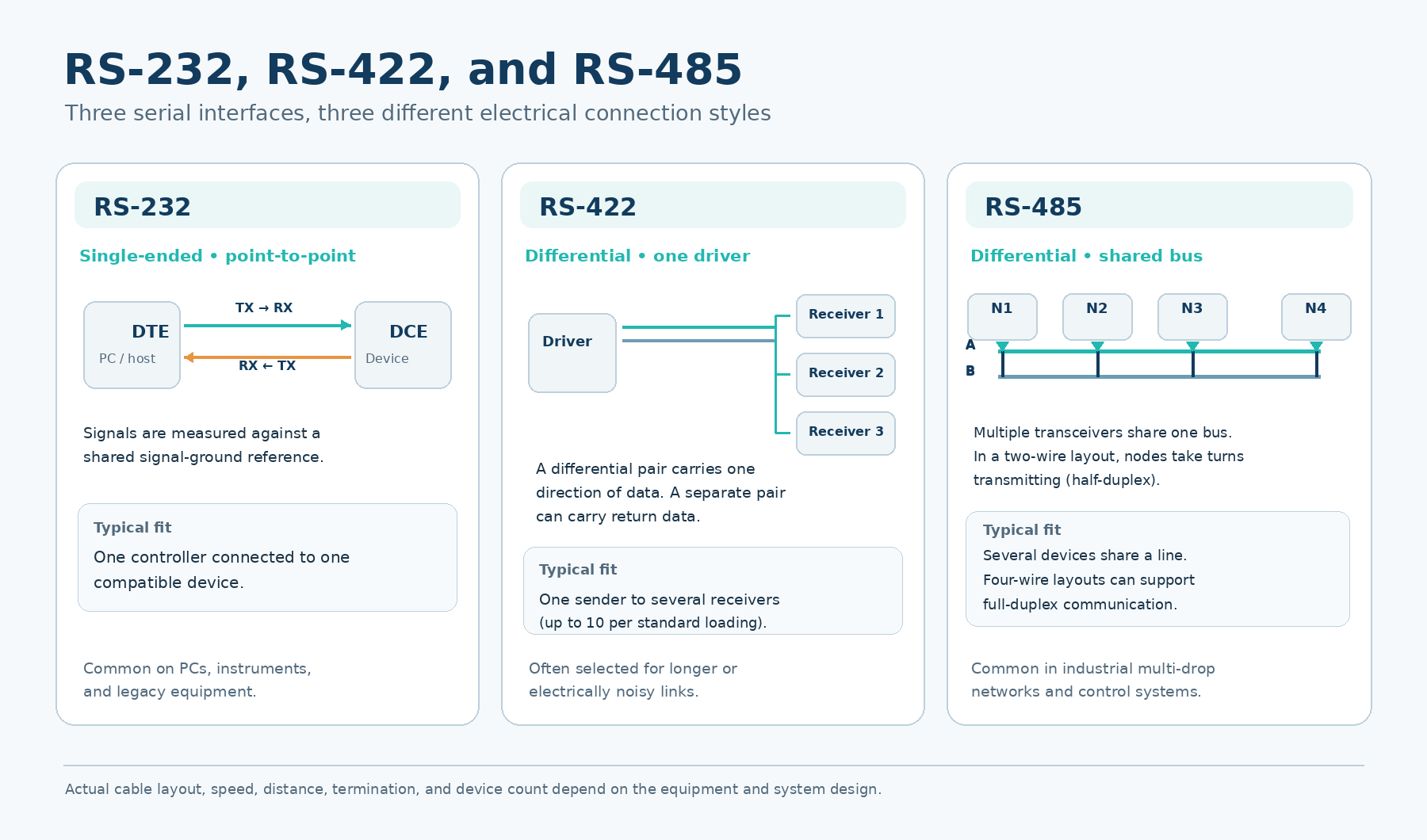
RS-232: a direct connection between two devices
RS-232 uses single-ended signals referenced to a shared signal ground. It is commonly used for point-to-point communication between a computer or controller and one compatible device.
A typical connection carries transmit data, receive data, and signal ground. The transmit signal from one end must reach the receive input at the other.
RS-422: differential signaling from one driver
RS-422 uses a differential signal pair, which can provide better noise immunity than single-ended signaling. A common arrangement has one driver sending to one or more receivers. The standard supports one driver with up to 10 receiver loads on a line.
A full-duplex RS-422 setup uses separate differential pairs for the two directions of data. The equipment manual determines the actual wiring and pin assignments.
RS-485: a shared multi-device bus
RS-485 also uses differential signaling. It is widely used when multiple devices share a communication bus. In a common two-wire arrangement, devices take turns transmitting, so communication is half-duplex. Four-wire arrangements can support full-duplex communication.
The correct cable layout, termination, and device count depend on the transceivers and system design. Follow the equipment documentation.
Which one should you use?
-
RS-232: A direct connection between two compatible devices.
-
RS-422: A differential link where one driver sends to one or more receivers.
-
RS-485: A differential bus shared by multiple devices.
Check the interface listed for each device before selecting a cable or adapter. A USB-to-RS232 adapter provides an RS-232 interface; it does not convert that port to RS-422 or RS-485. A different interface or converter is needed when the device uses another standard.
If you need to connect a computer’s USB port to an RS-232 device, explore our USB-to-RS232 adapters.
For a practical DB9 wiring example, see How to Wire a DB9 RS-232 Null-Modem Cable.